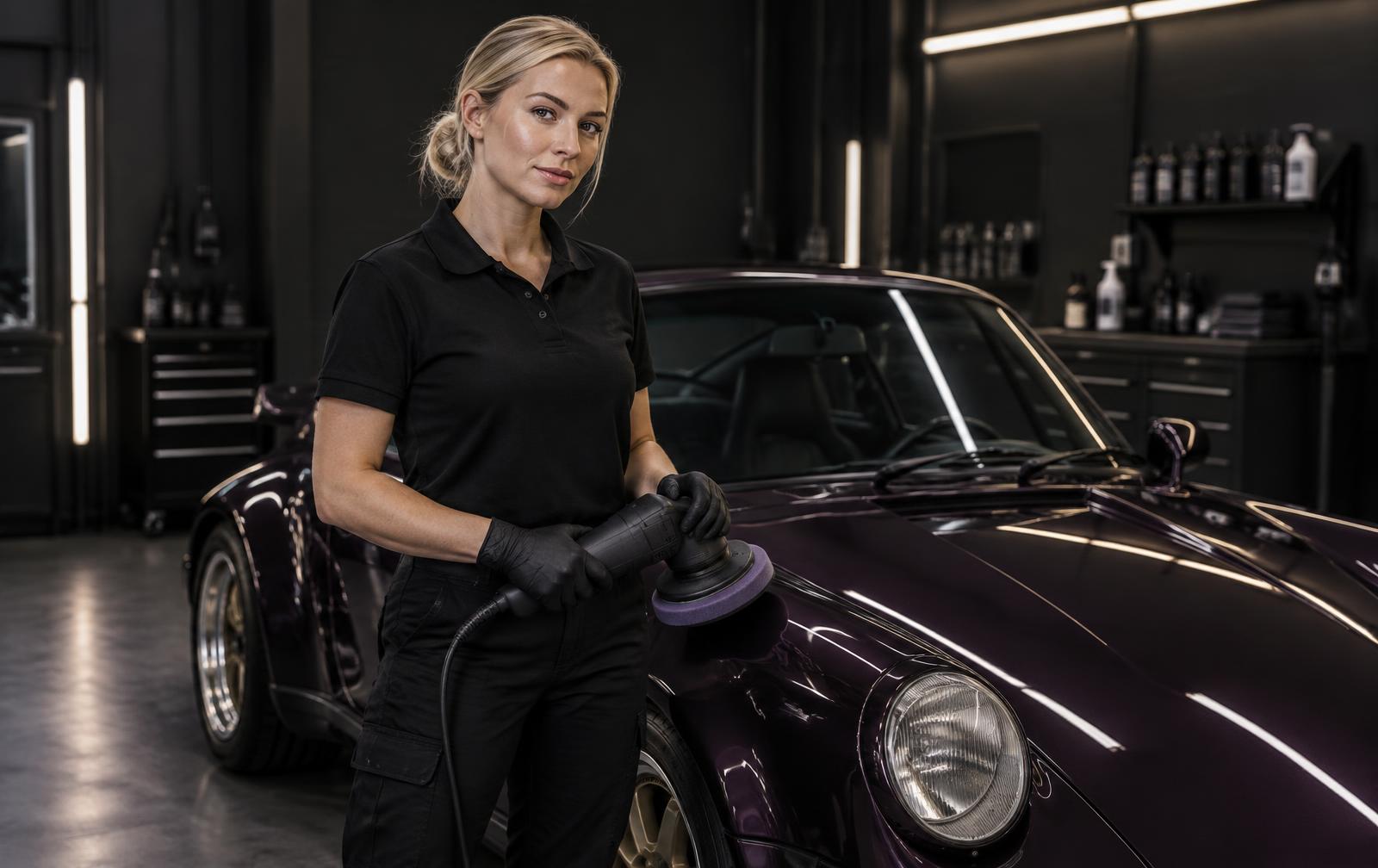
She walked into the workshop in high heels, a thin jacket and a question nobody expected from someone who looked like she had taken a wrong turn on her way to an office: "Can I watch you polish?" Today Gabija Vaitkute is one of the most visible detailing specialists in Lithuania and an expert and advisor for the HOCUS brand. The road from that first awkward laugh in a workshop to shaping how we wash and care for thousands of cars took eight years.
The first time nobody took her seriously
Gabija grew up in Kaunas, in a home where a car was simply the thing that took you to work. Her father had an old estate that he washed on Saturday mornings with one bucket and one sponge, and it was there, looking at the streaks left on dark paint, that she first thought something could be done better.
After school she worked in a hair salon, then in a shop. Cars stayed a hobby. She bought her first polisher second hand through a classified ad and tried it on the bonnet of her own old hatchback. The result was bad: holograms, a burnt edge and a lesson she still repeats in every consultation. "Polishing is not force. It is patience and light," she says.
When she first walked into a professional detailing shop to ask for work, the answer was polite and clear: this is hard physical work, there is dust, there are chemicals. She came back the next week. And the week after. On the fourth visit they let her wash wheels. Not because anyone believed in her, but because they were short of hands that day.
Eight years measured in surfaces, not diplomas
In detailing nobody asks what you studied. They ask how you handle black paint in direct sunlight and what you do when a customer arrives with three different layers of respray on one car. Gabija learned the way most of the best people in this trade learn: by doing, failing and measuring.
She started carrying a paint thickness gauge and a notebook. For every car: model, paint thickness on each panel, the compound used, the pad type, the speed, the temperature in the bay. After two years that notebook held more than four hundred entries. That was her university.
The turning point came when she was trusted with a classic coupe with original, very thin paint. The owner stood next to her the whole day. She worked slower than ever, changed the lighting, checked every few minutes and finished late in the evening. The next morning he called and asked her to take on two more cars. The queue never stopped after that.
Why a woman in a detailing bay is still news
Gabija does not like her story reduced to a story about gender. But she is also honest: for the first few years almost every new customer asked whether she would really do the work herself, or only take the keys. Some asked to speak to "the master".
Her answer was always the same: come back in a week, look at the work in daylight, and then decide. Practically all of them came back. Today about a third of her private clients are women, and many of them say the same thing: it was the first time a workshop explained what was being done and why, without mockery and without unnecessary jargon.
That habit of explaining is exactly what later brought her into the HOCUS team.
How she became a HOCUS expert and advisor
The meeting was pure coincidence. She drove into a HOCUS wash as a customer, with her own car, and afterwards gave very specific feedback: on microfibre rotation, on how long an alkaline product sits on the surface before rinsing, on drying order, and on how easily fine scratches are introduced in the final passes.
Instead of getting defensive, the team asked her to come back and say all of it out loud to everyone. A month later she was running the first internal training session. Today her role covers three things.
Process. She reviews and writes down how every step is performed, from the first rinse to the final inspection under light. Not to make things complicated, but so the result is identical at every location, every day.
Chemistry and equipment. Every new product goes to her first. She checks dilution, dwell time, the smell it leaves in a cabin, how it behaves on plastics, and whether it survives a Lithuanian winter full of road salt.
Training. With new staff she teaches what she learned the hard way: that ninety percent of the result is decided before a polisher ever touches the paint.
Five details she repeats in every training
1. Light matters more than equipment. Without proper lighting from several angles you cannot see what you are correcting. Most "invisible" defects are simply badly lit.
2. The two bucket rule is not marketing. Almost all fine swirl marks are created during washing and drying with a dirty mitt, not during polishing.
3. The interior is a health question, not a beauty one. Mats, vents and seat seams hold dust and odour. An air freshener only covers the problem.
4. A coating is not armour. A ceramic coating makes maintenance easier and protects against chemical staining, but it does not remove the need to wash correctly.
5. Budget the time in advance. Rushed work always shows. Better to delay by an hour than to correct for a week.
What changes for HOCUS customers
In practice her contribution shows up in small things. Stricter sorting and washing of microfibre. A clearer drying protocol so dark cars do not carry water spots. Shorter dwell times for chemicals in summer. One extra inspection under light before the keys are handed back.
To a customer it looks simple: the car just looks better and stays clean longer. Behind it are hundreds of hours with a gauge, a notebook and a lot of patience.
Advice for anyone who wants to start
When people ask where to begin, Gabija never suggests buying expensive equipment. "Buy good lighting, two buckets and ten quality microfibre towels. Practise on your own car for six months. If you still want it after six months, then we can talk about a polisher."
And one more thing she tells almost everyone: high heels do not keep you out of a workshop. Only an unwillingness to learn does.
You can now do all of this at home
Asked whether all of this is possible on your own driveway, Gabija just laughs. "Of course. Ninety percent of the result is not the equipment, it is the order of work and the right products. With a good shampoo, two buckets, quality microfibre and a clear sequence, your car will look better than after most quick washes."
That is exactly why she helped select the products now available in the HOCUS shop at shop.hocus.lt. "Every product was tested by our team on real cars in the bays, not only on a test panel. If something left streaks, smelled of harsh chemicals or failed in winter, it never reached the shelf."
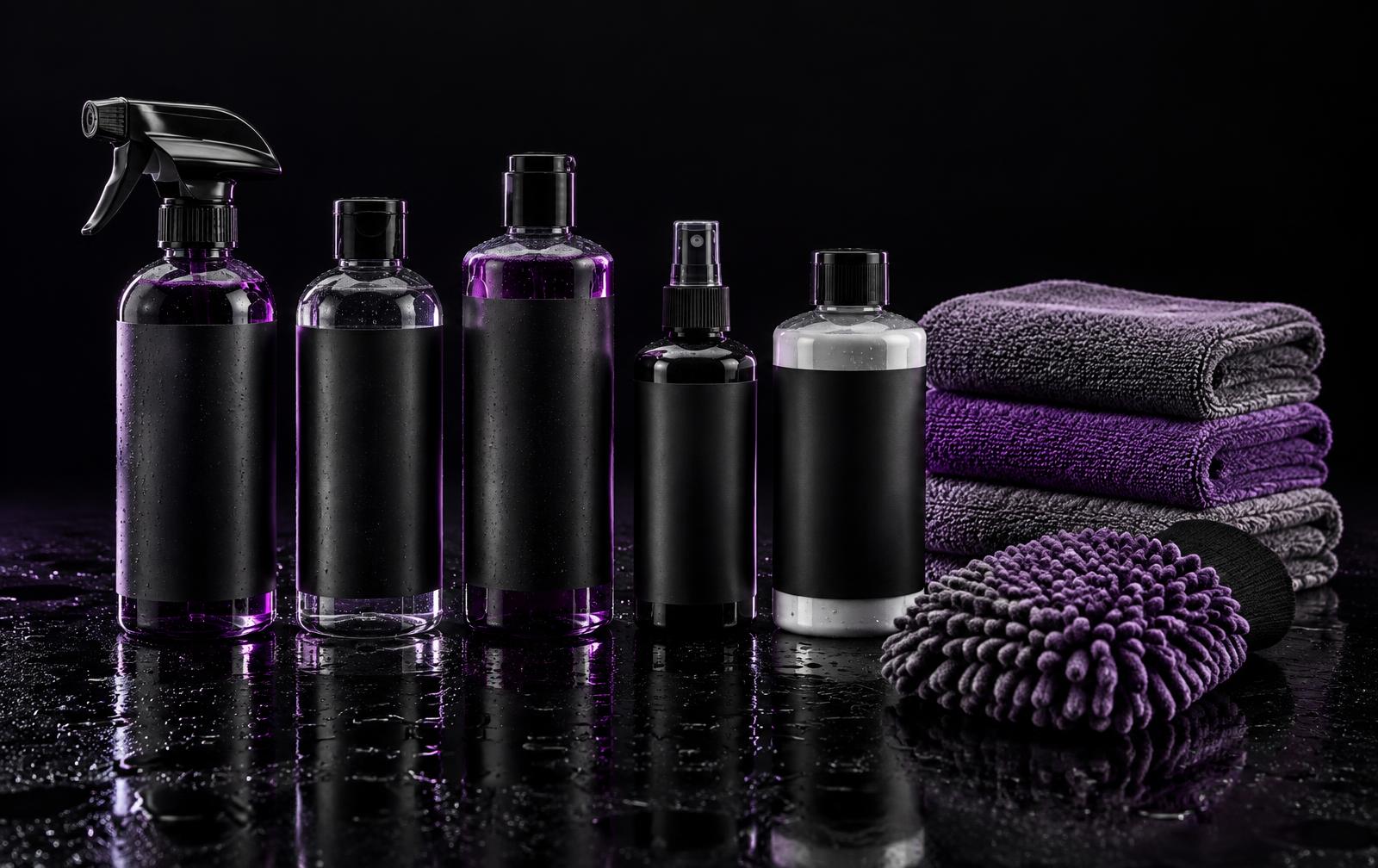
The shop carries a car shampoo with a wash mitt, a glass cleaner, a textile cleaner, a wheel cleaner, a tyre renewal set, a gloss booster, a drying towel and a complete car care set. Every product comes with clear brochures and explanation videos, so you can see how much to use, in what order to work and what to avoid.
"I like it when people look after their own car," Gabija says. "They notice the small things earlier than we do. And when polishing or a ceramic coating is really needed, they already understand why."